





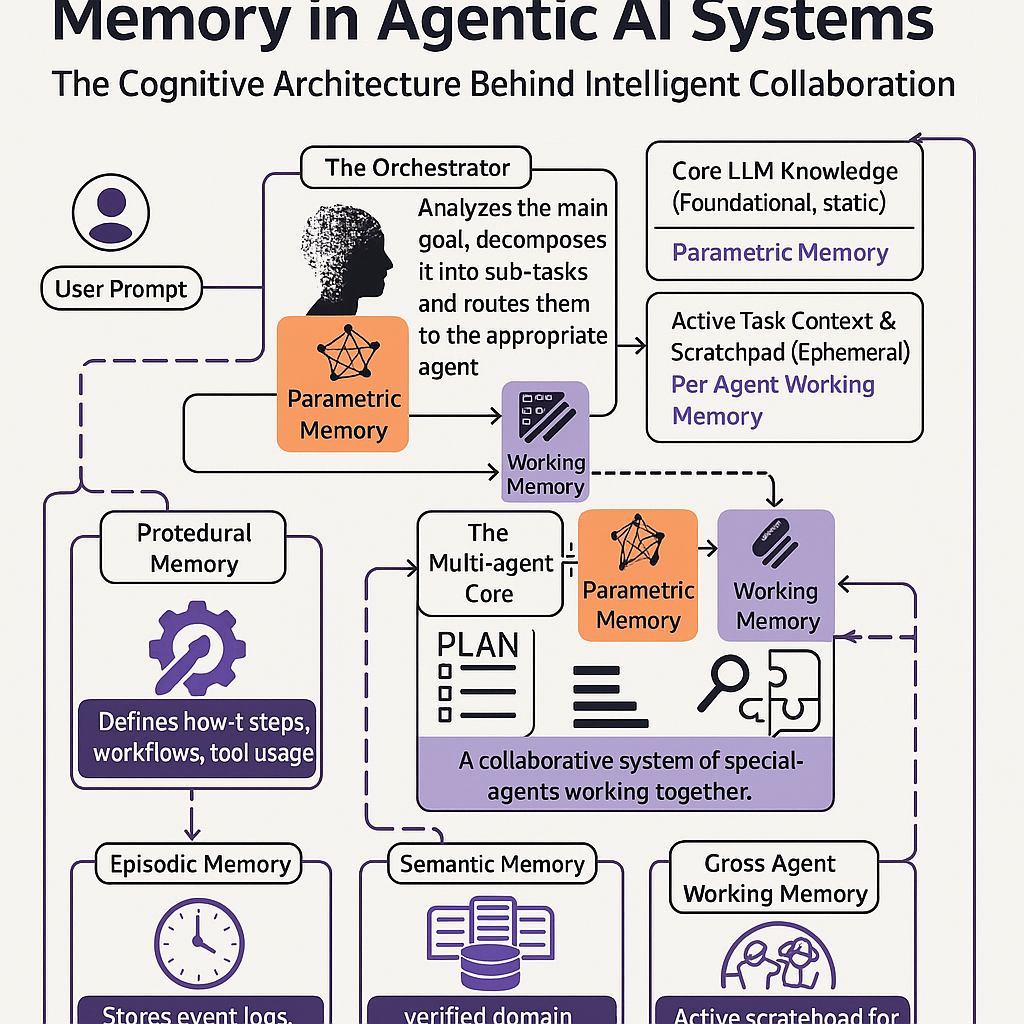
Agentic AI systems represent a significant leap beyond traditional automation and generative models. Unlike systems that simply respond to prompts or follow static rules, AI Services and AI Solutions can plan, reason, remember, act, evaluate outcomes, and iterate toward goals. To understand how these systems function, it is essential to explore their cognitive foundations. These foundations draw inspiration from human cognition, decision theory, neuroscience principles, and computational intelligence. By combining reasoning frameworks, memory architectures, planning algorithms, and feedback loops, agentic AI achieves a level of autonomy that enables it to operate in dynamic enterprise environments.
From Reactive Intelligence to Goal-Oriented Cognition
Traditional AI systems are largely reactive. They process inputs and generate outputs without persistent context or strategic awareness. Agentic AI, however, is built on goal-oriented cognition. This means the system can interpret a high-level objective, break it into sub-goals, evaluate alternative actions, and execute multi-step plans. The cognitive shift here is from “response generation” to “intent-driven behavior.”
At its core, this mirrors human executive function. Humans set goals, assess available resources, predict outcomes, and adjust actions based on feedback. Agentic AI systems replicate this loop through structured reasoning modules, planning algorithms, and iterative evaluation mechanisms.
Perception: Understanding Inputs and Context
Every cognitive system begins with perception. In agentic AI, perception involves interpreting structured and unstructured data, including text, numerical inputs, system logs, APIs, and external tools. Large language models often serve as the perception layer, converting raw data into semantic understanding.
However, perception in agentic AI goes beyond simple pattern recognition. It includes contextual grounding. For example, when deployed in enterprise environments, an agent must understand organizational hierarchies, workflow dependencies, compliance requirements, and historical data patterns. This contextual awareness enables more accurate decision-making and reduces operational risk.
Memory: The Backbone of Intelligent Autonomy
Memory is one of the most critical cognitive foundations of agentic AI. Without memory, systems cannot learn from past actions or maintain long-term context. Advanced agentic systems incorporate multiple memory layers, including short-term working memory, episodic memory, and long-term knowledge storage.
Working memory stores current task context, intermediate outputs, and planning steps. Episodic memory records previous interactions, successes, and failures. Long-term memory connects the agent to structured knowledge bases, enterprise databases, and external documents.
Together, these memory systems allow agents to adapt over time, refine strategies, and avoid repeating mistakes. In enterprise deployments, memory ensures continuity across projects, customers, and operational cycles.
Reasoning and Decision Loops
At the heart of agentic cognition lies reasoning. Agentic AI systems rely on structured decision loops to evaluate possible actions. These loops typically follow a cycle: observe, plan, act, evaluate, and adjust.
Observation gathers contextual data. Planning decomposes objectives into actionable steps. Action executes tasks through APIs or system commands. Evaluation assesses outcomes against predefined goals. Adjustment refines the strategy if outcomes fall short.
This iterative loop mirrors cognitive decision-making models studied in psychology and control theory. It enables systems to handle uncertainty, respond to environmental changes, and continuously improve performance.
Planning and Goal Decomposition
One of the defining cognitive abilities of agentic AI is hierarchical planning. Instead of attempting to solve complex objectives in a single step, agentic systems break them into manageable subtasks. This process, known as goal decomposition, enhances clarity and efficiency.
For example, if tasked with generating a quarterly financial report, the agent might first retrieve relevant data, validate data integrity, compute metrics, draft the report, and finally review it against compliance rules. Each subtask can be monitored, corrected, or optimized independently.
Hierarchical planning reduces cognitive overload and increases reliability in complex environments.
Learning Through Feedback and Adaptation
Cognitive systems improve through feedback. Agentic AI solutions integrates feedback mechanisms at multiple levels. Immediate feedback evaluates task completion accuracy. Human-in-the-loop feedback ensures compliance and strategic alignment. Performance analytics provide long-term optimization insights.
Continuous learning mechanisms allow agents to refine prompts, adjust task sequencing, and optimize decision thresholds. Over time, this creates adaptive systems capable of evolving alongside enterprise needs.
Tool Use and Environmental Interaction
Another foundational cognitive capability is tool use. Human intelligence is amplified by tools, and agentic AI follows the same principle. Agents interact with databases, enterprise software, APIs, cloud services, and analytics platforms.
Tool integration expands the operational reach of the agent. Rather than generating theoretical outputs, it performs real actions such as updating records, sending communications, analyzing data, or orchestrating workflows. This interaction between cognition and environment defines true autonomy.
Uncertainty Management and Probabilistic Thinking
Enterprise environments are unpredictable. Data may be incomplete, ambiguous, or noisy. Agentic AI systems rely on probabilistic reasoning to handle uncertainty. Instead of assuming absolute correctness, they evaluate confidence levels and consider alternative actions.
This probabilistic thinking allows agents to escalate ambiguous cases to humans, request additional data, or test multiple strategies before finalizing decisions. Such behavior enhances robustness and reduces operational risk.
Ethical Constraints and Cognitive Guardrails
Advanced cognition also requires constraints. Agentic AI systems incorporate ethical guardrails, policy constraints, and compliance checks within their decision loops. These guardrails function as cognitive boundaries, ensuring that autonomy does not override governance requirements.
By embedding constraints directly into planning modules, organizations maintain control while enabling intelligent autonomy.
The Convergence of Cognitive Science and Engineering
The development of agentic AI represents a convergence between cognitive science principles and computational engineering. Concepts such as working memory, executive function, reinforcement learning, and decision theory are translated into scalable architectures.
This interdisciplinary foundation enables agentic AI to operate not merely as a language model but as an autonomous problem-solving system capable of sustained strategic action.
Final Thoughts
The cognitive foundations behind agentic AI systems reveal why they are fundamentally different from earlier AI technologies. By combining perception, memory, reasoning, planning, feedback loops, and environmental interaction, these systems move closer to human-like problem-solving capabilities.For enterprises, understanding these cognitive underpinnings is crucial. It informs architecture design, governance frameworks, and strategic deployment decisions. Agentic AI is not just about automation; it is about embedding structured intelligence into digital systems that can think, adapt, and act with purpose.

